Water Damage Tips for Homeowners
Practical guidance from Capital Region restoration work — what to do, what to avoid, and how to protect your insurance claim.
Homeowner Guide
Water Damage Tips for Capital Region Homeowners
Most water damage emergencies start with a homeowner who has no plan and 30 seconds to make decisions that will affect the next month of their life. Here's what to do — and what to avoid — based on thousands of jobs across the Capital Region.
The First Hour
Safety first
Get people and pets out of the affected area. Standing water plus electricity is the biggest hazard — outlets, plugged-in appliances, and submerged extension cords all create electrocution risk. If you can do it safely, kill power to the affected area at the breaker. If the panel itself is in the flooded space, don't go down there. Call us, we'll talk through it.
Stop the source
Burst pipe — main shut-off, usually in the basement near where the water enters or outside near the meter. Appliance leak — supply valve behind the unit. Sewer backup — stop using all water in the house immediately. Roof leak — buckets and tarps, move what you can away from the drip path.
Call professionals
A trained crew with truck-mounted extraction can move water in volumes a homeowner with a shop vac will be working on for days. Calling early — even before you fully understand the scope — is almost always the right move.
Documentation Tips
Before you move anything, before the crew arrives, take photos and video of everything. Insurance adjusters want to see the damage in place. Specifically capture:
- Wide shots of every affected room from multiple angles
- Close-ups of damaged contents — furniture, electronics, books, clothing
- The water source if visible — burst pipe, overflowing fixture, leaking appliance
- Any physical damage — warped flooring, swollen drywall, ceiling stains
- The exterior if storm damage is involved — shingles, siding, gutters
What to Save, What to Throw Away
Some materials are nearly always salvageable. Some are nearly always tear-out. Here's the rough framework:
Usually salvageable
- Solid wood furniture — dries out, may need refinishing
- Hard surface flooring (tile, vinyl, sealed concrete)
- Most framing lumber if dried promptly
- Sealed wall cavities if dried before mold establishes
- Books, photos, and papers if dried fast (freeze-dry process for high-value items)
Often salvageable with prompt action
- Carpet (if Category 1 water and dried within 48 hours, with cushion replaced)
- Hardwood flooring (Class 4 specialty drying, takes longer)
- Upholstered furniture (depends on water category and saturation level)
- Electronics that weren't powered on when wet (require professional drying)
Almost always tear-out
- Saturated insulation — both ineffective wet and a future mold reservoir
- Drywall flooded above 2–3 inches — flood-cut at minimum
- Ceiling tiles that have absorbed water
- Particle board and engineered flooring substrates
- Anything that contacted Category 3 (black) water — porous materials cannot be saved
- Mattresses and pillows that absorbed any water
- Cardboard storage boxes (and often their contents if porous)
Common DIY Mistakes
- Using bleach on mold. Bleach doesn't kill mold roots on porous materials. The mold returns — sometimes worse than before.
- Running the central HVAC during a water event. The system pulls moisture and contaminants throughout the house, spreading the problem.
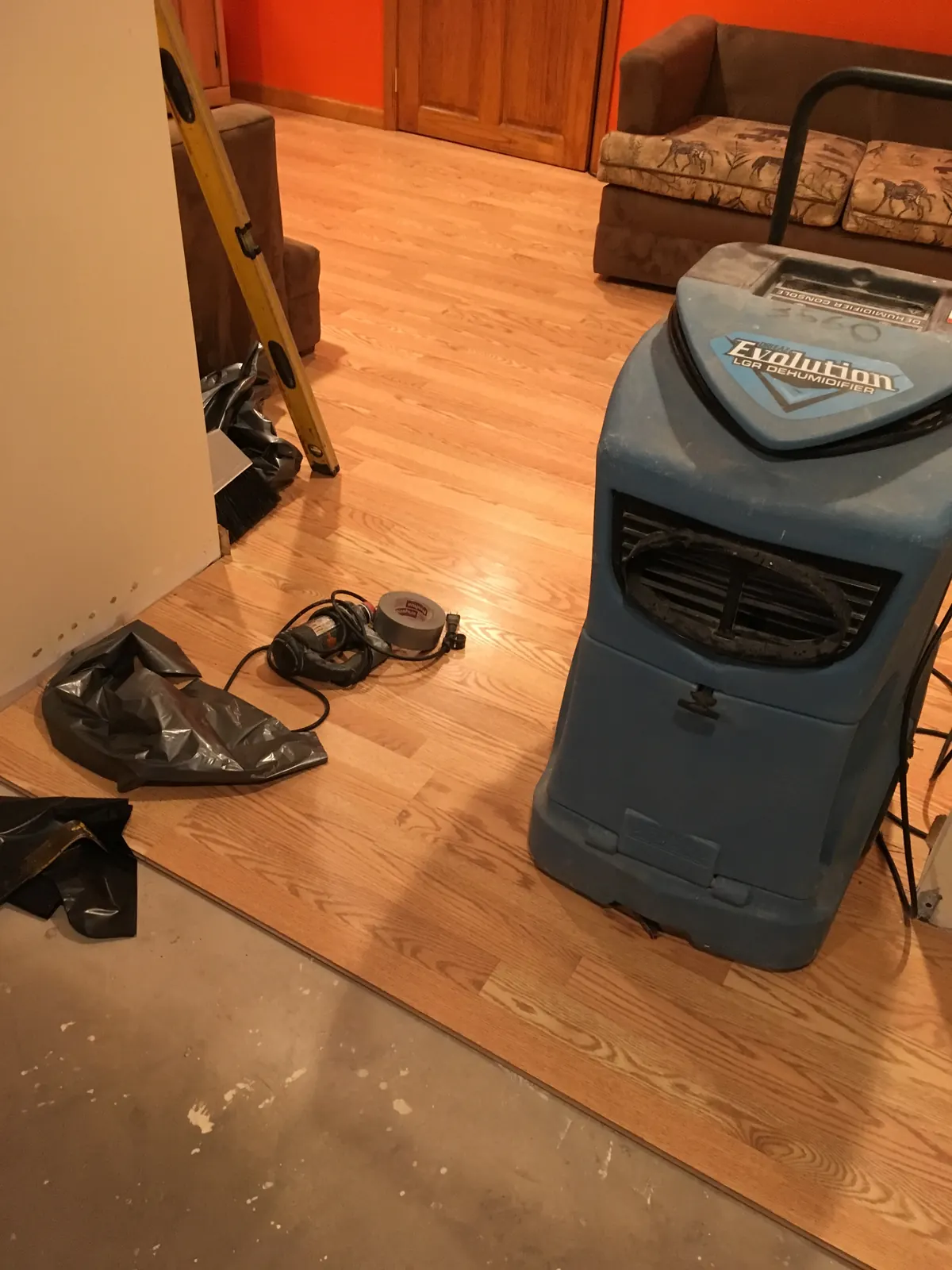
- Trying to dry without dehumidification. Air movers without dehumidifiers just move wet air around. Moisture has to go somewhere — that's the dehumidifier's job.
- Removing equipment too early. Surfaces feel dry before they actually are. Moisture meters tell the truth, hands don't.
- Painting over water-damaged drywall. Paint doesn't fix moisture. The damage shows back through within months.
- Not calling a professional because "it's only a little water." A little water in the wrong place — inside a wall, under flooring — can cause six months of mold growth before it becomes obvious.
Insurance Claim Tips
- Document everything before you move it. Photos, video, written list.
- Call your carrier promptly. Most policies require timely notice.
- Keep receipts for everything — emergency hotel, replacement clothing, materials.
- Don't dispose of damaged items until the adjuster has seen them, or unless they pose a safety risk.
- Work with a restoration contractor who documents to insurance standards. The documentation is what determines coverage.
- Read your policy. Specifically understand water backup endorsements, flood exclusions, and mold caps.
Prevention
Most water emergencies are predictable enough to mitigate:
- Replace washing machine supply hoses every 5–7 years
- Service the water heater annually
- Test the sump pump twice a year, replace it every 7–10 years
- Add a water-backup endorsement to your homeowners policy if you have a basement
- Know where the main water shut-off is — and that it actually works
- Insulate pipes in unheated spaces before winter
- Clean gutters in late fall to prevent ice dams
- Address foundation cracks and grading issues before water can find them