How to Remove Mold After Floods
Floods almost always cause mold. Once it's there, removal is its own discipline — separate from water damage cleanup.
Mold · Albany NY
Removing Mold After Floods — What Actually Works
Floods almost always lead to mold. Within 24–48 hours of water exposure, spores find wet substrates and begin colonizing. The window between flood and mold is narrow, which is why prompt extraction and proper drying matter more than people realize. But once mold has established itself, removal is its own discipline — separate from the water damage cleanup that came before.
Why Floods Almost Always Cause Mold
Several factors combine to make post-flood environments ideal for mold colonization:
- Moisture is abundant — porous materials are saturated
- Spore food sources are everywhere — paper-faced drywall, organic material in dust, wood
- Temperature is favorable — typical indoor temps are perfect for most mold species
- Containment is poor — water has spread into wall cavities and other hidden spaces
- Time has passed — by the time anyone realizes the scope, the 24–48 hour window has often closed
- Floodwater itself carries spores — outside floodwater introduces new spore species into the home
This is why even fully professional water damage restoration sometimes leads to mold — the conditions tilted the odds.
What Mold Removal Actually Requires
Containment first
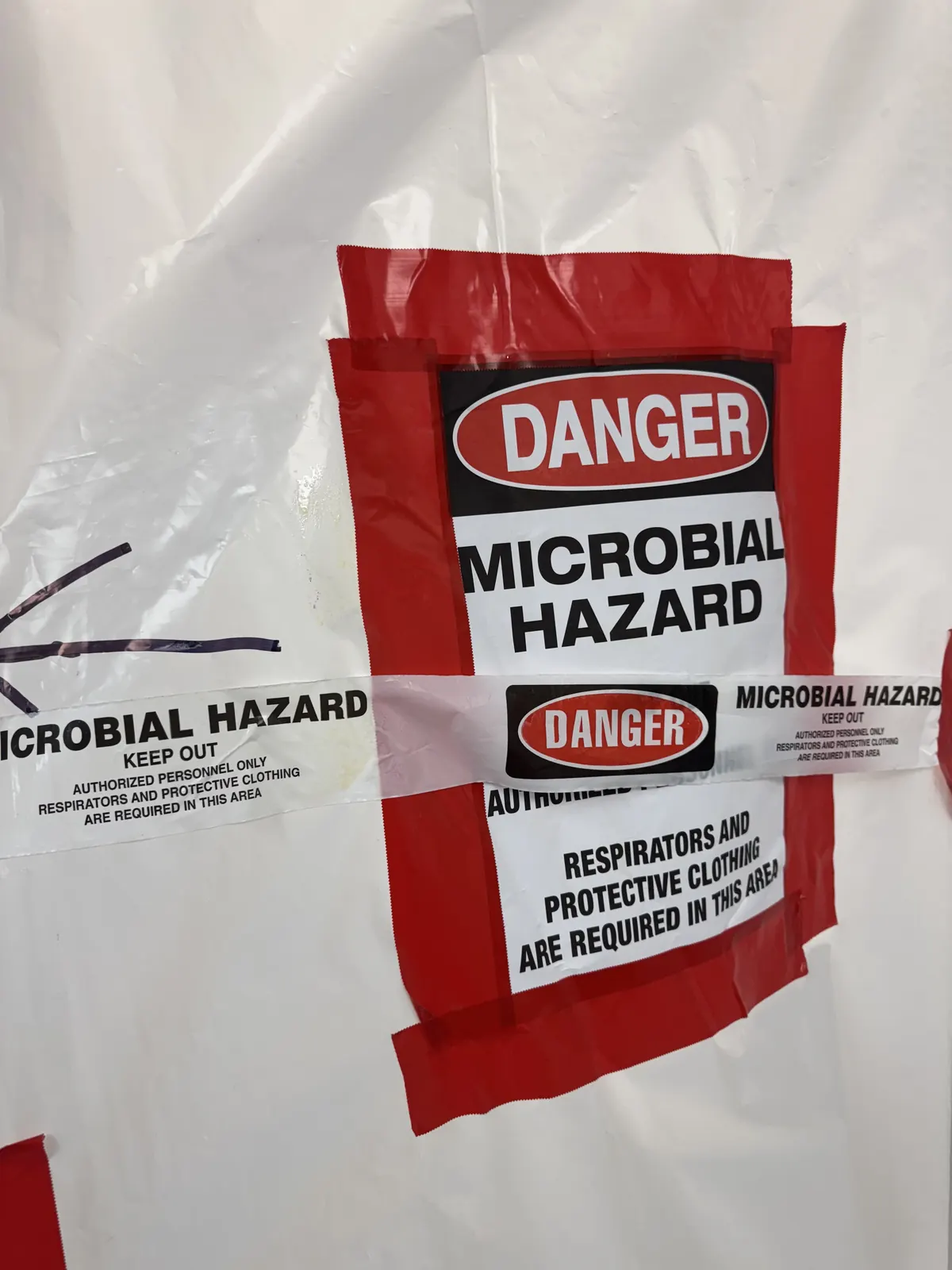
Mold doesn't just sit there waiting to be cleaned. Disturbing it releases millions of spores into the air. If those spores migrate to other parts of the house — driven by HVAC airflow or simple foot traffic — the problem spreads. Professional removal always starts with containment: 6-mil polyethylene barriers around the work area, negative-air HEPA scrubbers establishing a pressure differential that pulls air into the work area instead of letting it escape.
Removal of porous materials with established growth
Drywall, insulation, carpet, ceiling tiles, particle board — once mold has established roots in porous materials, the materials cannot be cleaned to a satisfactory standard. They come out, get bagged, and go to disposal as contaminated waste. Trying to clean instead of remove guarantees the problem returns.
HEPA vacuuming and surface cleaning
Semi-porous materials (wood framing, sub-flooring) are HEPA-vacuumed (HEPA, not standard vacuum) and treated with appropriate antimicrobial agents. Hard surfaces are wiped down with appropriate cleaners.
Air quality recovery
Air scrubbers continue running through and after cleanup. The work area's air has to be cleaned before containment can come down — otherwise the spores released during removal end up dispersing through the rest of the home anyway.
Source remediation
This is where many mold jobs fail. If the moisture source isn't addressed, the mold returns. Foundation seepage that wasn't sealed. The ice dam path that wasn't fixed. The slow plumbing leak that wasn't repaired. Mold remediation without source remediation is a temporary fix at best.
What Doesn't Work
- Spraying bleach on mold. Doesn't kill roots on porous materials.
- "Painting over it" with mold-resistant paint. Doesn't address what's underneath.
- Dehumidifying without remediating. Drying out won't kill established colonies.
- Sealing without removing. Encapsulation has very limited applications and almost never applies to typical residential mold.
- Cleaning visible surfaces without checking inside walls. The visible patch is the symptom, not the problem.
The Real Goal
Successful mold remediation has three measurable outcomes:
- The visible growth is gone
- Air sample testing shows indoor spore counts at or below outdoor reference
- The moisture source has been addressed so mold doesn't return
If any one of those three is missing, the job isn't done.
Getting Help in the Capital Region
If your home flooded recently and you're seeing or smelling mold, time matters. Call 518-788-7261. We'll do a thorough inspection, identify the moisture source, scope the remediation needed, and handle it under IICRC S520 protocols. The Dry Boys of Albany was named Top Mold Remediation Company in Albany 2023 by Expertise.com — not because we sell the cheapest mold work, but because we do it correctly the first time.