What Water Damage Restoration Costs in Albany NY
Honest cost ranges based on thousands of Capital Region jobs — by water category, IICRC class, and scope. Plus what insurance typically covers.
Water Damage · Albany NY
What Water Damage Restoration Actually Costs in Albany NY
Cost is the question most homeowners ask first when they call. The honest answer is: it depends on a handful of variables that can be assessed only on-site. But there's enough pattern across thousands of Capital Region jobs to give meaningful ranges.
Here's how restoration cost actually breaks down — by water category, by IICRC class, and by typical scope.
The Cost Variables
Water Category
- Category 1 (clean): lowest cost — materials are salvageable, no biocide work, standard PPE
- Category 2 (grey): moderate cost — some materials must be removed, antimicrobial treatment required
- Category 3 (black/sewage): highest cost — extensive material removal, full PPE, biocide treatment, contaminated waste disposal
IICRC Class
- Class 1: minimal absorption — short drying time, low equipment count
- Class 2: typical residential basement — moderate equipment, 3-5 days
- Class 3: water from above, ceilings/walls/insulation affected — higher equipment count, possible demolition
- Class 4: specialty drying for hardwood, plaster, masonry — longer timeline, specialty equipment
Affected Square Footage
Larger affected areas require more equipment, more daily monitoring time, and more disposal volume. Cost scales with square footage but not linearly — the first 200 square feet is more expensive per foot than the next 1,000.
Reconstruction
Restoration cost typically excludes reconstruction (drywall replacement, flooring re-installation, painting). Reconstruction is its own scope, billed separately, and often handled by a different contractor.
Typical Capital Region Cost Ranges
Small Category 1 / Class 1 — $500–1,500
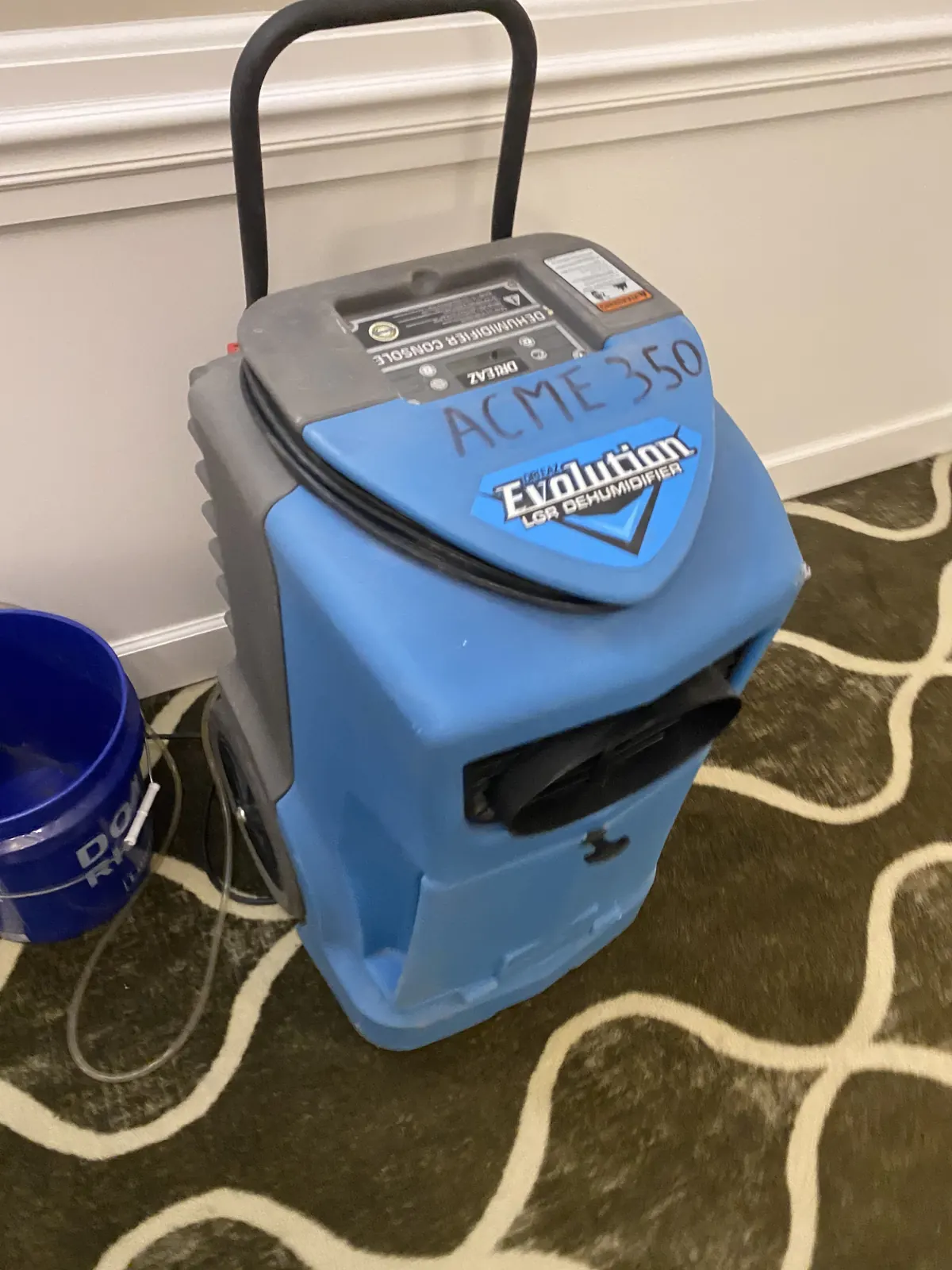
Caught quickly. Limited area. Material absorption minimal. Example: a slow leak under a kitchen sink discovered same-day, affecting cabinet base and a small floor area. Extraction, drying with 1-2 air movers and a dehumidifier for 1-2 days.
Standard residential basement flood — $1,500–4,000
Category 1 or Category 2 source. Class 2 absorption. 600-1,200 square feet affected. Carpet/pad removal, drywall flood-cut to 24", structural drying with multiple dehumidifiers and air movers over 3-5 days. This is the most common Capital Region job.
Whole-floor water loss — $4,000–10,000
Larger event affecting an entire floor. Category 1 or 2. Class 2 or 3. Significant material removal, multi-room equipment placement, 5-7 days of drying.
Sewer backup / Category 3 — $4,000–12,000+
Category 3 means full material removal of anything porous that contacted the water. Plus contaminated waste disposal. Plus antimicrobial treatment. Plus full PPE crews. Pricing depends heavily on how much porous material is removed.
Whole-home flood / major loss — $10,000–30,000+
Major event affecting multiple floors. Often combined with mold remediation if response was delayed. Significant demolition. Multi-week timeline. Insurance-billed almost without exception.
Mold remediation — $1,500–8,000+ (separate from water damage)
Mold work scope depends on affected area, accessibility, containment requirements, and material removal. Small kitchen-cabinet mold may run $1,500-2,500. Whole-basement remediation can run $5,000-8,000. Larger remediation involving HVAC contamination or extensive wall cavity work runs higher.
What Insurance Typically Covers
Generally covered
- Sudden and accidental water damage from burst pipes
- Appliance failures (washing machines, dishwashers, water heaters)
- Storm-related water intrusion through covered loss (storm-damaged roof or window)
- Ice dam intrusion
Coverage requires endorsement
- Sewer backup
- Sump pump failure
Generally not covered
- Gradual leaks the homeowner should have noticed
- Maintenance-related issues
- Surface flooding from outside (requires separate flood insurance)
- Mold from chronic neglected leaks
What Drives Cost Up
- Delayed response — every additional hour means more material absorption and more remediation
- Hidden water — moisture trapped in wall cavities or under flooring extends drying time and may require additional demolition
- Category degradation — Category 1 water that sits 48+ hours becomes Category 2, doubling some scope items
- Specialty materials — hardwood floors, plaster walls, brick require Class 4 specialty drying
- Scope expansion during work — discoveries that weren't visible at initial assessment
What Drives Cost Down
- Fast response — extraction within hours preserves materials
- Caught early — small problems cost small money
- Working with a documenting contractor — proper insurance billing reduces homeowner out-of-pocket
- Address moisture source promptly — preventing degradation to Category 2
Getting an Estimate
Free on-site assessments are standard for any reputable restoration contractor. Estimates given over the phone or via email without seeing the property are guesses — sometimes good guesses, but always less reliable than an in-person scope.
Call 518-788-7261 for a free Capital Region assessment. We'll walk the property, document moisture readings, classify the water and damage class, and give you a written scope that's accurate enough to make decisions on.